ShopDreamUp AI ArtDreamUp
Deviation Actions


Suggested Deviants


Suggested Collections


You Might Like…


Featured in Groups




Description
Other tutorials available here: [link]
INFO BELOW will eventually become it's own tutorial.
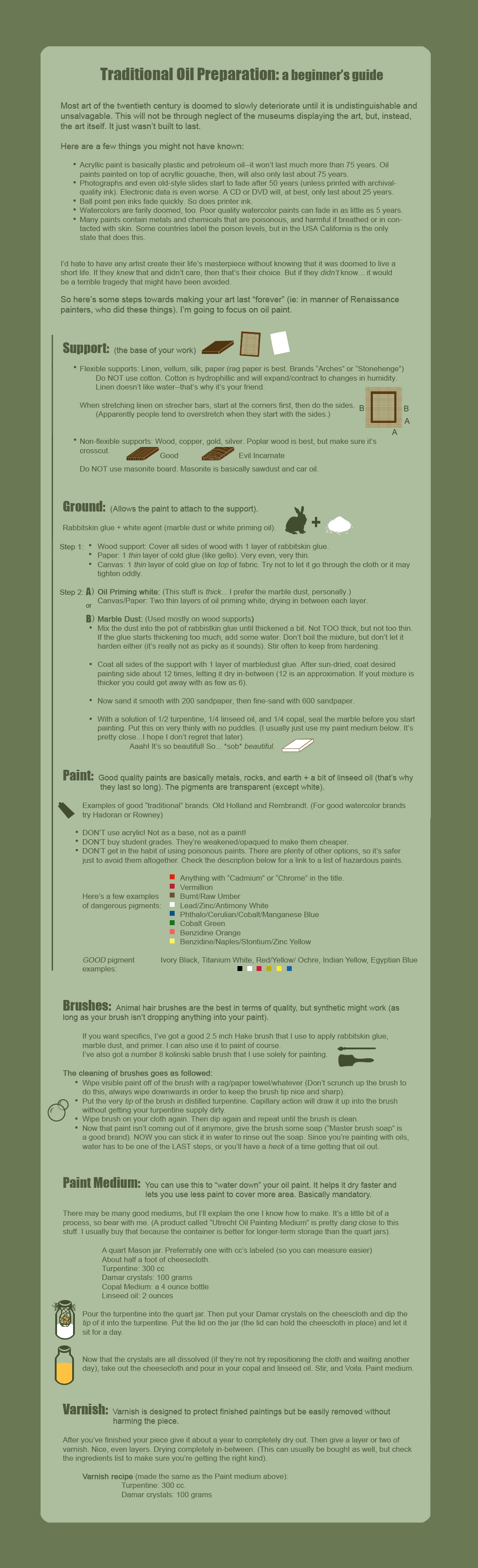
Cheap oil paint dries slowly. Better oil paint actually dries faster--but the thicker you apply it, the slower it dries. If you want to speed up this process, you can buy Cobalt drier (but only use about 2-3 drops at a time, and don't touch it to yourself. It's poisonous).
When it comes to the actual painting itself:
Option 1: Alla-prima: painted all at one time. Metal paints may react chemically with other paints, so you have to be careful about what you mix. In an ideal circumstance, you wouldn't mix anything. But that requires many MANY different shades of color (one artist had 40 yellows, for instance)... I'm too lazy for that. So I just try and get pigments that can mix without chemically reacting.
Option 2: Grisaille: black/white underpainting. Color glazes are applied on top of the grisaille, each glaze drying completely before applying the new one. (A color glaze is just the oil paint combined with your paint medium).
Advice:
--Since your color is transparent, you can't make it lighter than it is (unless you buy a lighter color). Putting a grey or black underneath it, however, can make it darker.
--Many thin glazes of color are better than a few thick ones. Light refracts through each layer, making the color more vibrant and alive. If you have thick layers, it just bounces off of the first one and looks rather dull.
--Completely finish glazing each individual color before moving on to another one. Generally start with yellow or red.
--You can apply a color glaze over the entire painting and then rub off the areas you don't want that color in with a cotton rag. It's faster.
--You can get the appearance of one color without actually using it. A grey put next to a red-ish yellow makes the grey look more blue. Likewise, a very thin yellow on grey looks green when next to a yellow-red. Experiment a bit to see what you can get.
INFO BELOW will eventually become it's own tutorial.
Cheap oil paint dries slowly. Better oil paint actually dries faster--but the thicker you apply it, the slower it dries. If you want to speed up this process, you can buy Cobalt drier (but only use about 2-3 drops at a time, and don't touch it to yourself. It's poisonous).
When it comes to the actual painting itself:
Option 1: Alla-prima: painted all at one time. Metal paints may react chemically with other paints, so you have to be careful about what you mix. In an ideal circumstance, you wouldn't mix anything. But that requires many MANY different shades of color (one artist had 40 yellows, for instance)... I'm too lazy for that. So I just try and get pigments that can mix without chemically reacting.
Option 2: Grisaille: black/white underpainting. Color glazes are applied on top of the grisaille, each glaze drying completely before applying the new one. (A color glaze is just the oil paint combined with your paint medium).
Advice:
--Since your color is transparent, you can't make it lighter than it is (unless you buy a lighter color). Putting a grey or black underneath it, however, can make it darker.
--Many thin glazes of color are better than a few thick ones. Light refracts through each layer, making the color more vibrant and alive. If you have thick layers, it just bounces off of the first one and looks rather dull.
--Completely finish glazing each individual color before moving on to another one. Generally start with yellow or red.
--You can apply a color glaze over the entire painting and then rub off the areas you don't want that color in with a cotton rag. It's faster.
--You can get the appearance of one color without actually using it. A grey put next to a red-ish yellow makes the grey look more blue. Likewise, a very thin yellow on grey looks green when next to a yellow-red. Experiment a bit to see what you can get.
Image size
1073x3522px 686.35 KB
© 2009 - 2024 Carlotta4th
Comments27
Join the community to add your comment. Already a deviant? Log In

Wait wait wait....am I going to get ill if poisonous paint gets on my hand and or arms??!!!